
EYE HEALTH
Maintaining good eye health is important because healthy eyes protect our vision, support learning and everyday activities, and help reduce the risk of preventable eye problems and vision loss throughout life.
UV radiation from our sun has a significant role to play in the health of our eyes.
Australia has some of the highest levels of ultraviolet radiation in the world. Our outdoor lifestyle is wonderful—but it also means Australian children receive significant UV exposure while playing, swimming, participating in sport and simply enjoying childhood.
UV reaches the eyes in many ways. It is reflected from:
- Water
- Sand
- Concrete
- Roads
- Buildings
- Snow
Even on cooler or cloudy days, significant UV radiation may still be present. A hat provides valuable protection, but it cannot block all UV entering the eyes from the side, below or by reflection.
In a healthy eye, light passes through the front of the eye, through the healthy lens and is focussed on the retina to record an image, which is then transmitted via the optic nerve to the brain for processing and recognition.

UV radiation from the sun enters the eye with this light and traverses a similar path doing damage in each and every structure of the eye, along the way.
The only way we can prevent this damage is to protect our eyes from this UV radiation and wear quality, well fitting sunglasses that block UV A and UV B rays (UV400nm). Idol Eyes sunglasses are designed to achieve this.
Why This Matters for Children
- The human eye continues to develop throughout childhood. During the early years of life, the eye's natural UV-filtering structures are still maturing. As a result, far more ultraviolet radiation can pass through a baby's eye than through the eye of an adult.
- As children grow, the eye gradually develops its natural filtering ability, but during infancy and childhood the eye remains particularly vulnerable to UV exposure. This is why protecting children's eyes from the very beginning is so important.
Parents have a unique opportunity to establish healthy habits from the earliest years of life to protect the eyes of their children. Just as we teach children to wear hats and apply sunscreen, we can also teach them to wear quality sunglasses whenever they are outdoors. Those simple habits may help protect their vision for decades to come.
Many UV-related eye diseases don't become obvious until adulthood. By the time they appear, the damage has accumulated over decades. This is why prevention matters.
How UV Radiation Affects the Eye
Ultraviolet radiation can affect almost every structure of the eye—from the delicate skin surrounding the eyes through to the retina at the back of the eye.
Eyelids and Surrounding Skin
The thin skin around the eyes receives some of the highest lifetime UV exposure on the body. Approximately 10% of skin cancers occur around the eyes, particularly on the lower eyelid where sunscreen is often difficult to apply effectively. Appropriately fitted sunglasses help provide protection for this vulnerable area.
The Cornea
Acute exposure to intense UV radiation can cause photokeratitis—often described as sunburn of the eye. Symptoms may include severe pain, redness, watering, blurred vision and sensitivity to light. Fortunately this usually resolves, but repeated exposure should be avoided.
The Conjunctiva
Long-term UV exposure is strongly associated with conditions such as pinguecula and pterygium—a growth of conjunctival tissue that extends across the cornea and may eventually interfere with vision. Research consistently shows that wearing sunglasses substantially reduces the risk of developing these conditions.
The Lens
Ultraviolet radiation contributes to cumulative damage within the eye's natural lens. Over time this damage is associated with the development of cataracts, one of the leading causes of vision impairment worldwide.
The Retina
Although much UV is absorbed before reaching the retina, children's eyes allow considerably more ultraviolet radiation to penetrate than adult eyes because the natural lens is clearer during early life. Reducing UV exposure throughout childhood helps reduce lifetime retinal exposure.
Early prevention is the best approach to avoiding this cumulative damage to your child’s eyes, by providing them with premium quality well-fitting sunglasses designed specifically for children, as they grow from tiny babies through to their teens.
Be Aware!
Why Quality Matters
For Australian conditions, sunglasses should meet the following standards:
- Comply with AS/NZS 1067.1:2016
- Provide high UV protection
- Fit comfortably and securely
- Provide good coverage around the eyes
- Stay in place during play
- Wraparound design for side protection
Why Wraparound Sunglasses Provide Superior Protection
UV rays can come from many directions – including the sides, above and below.
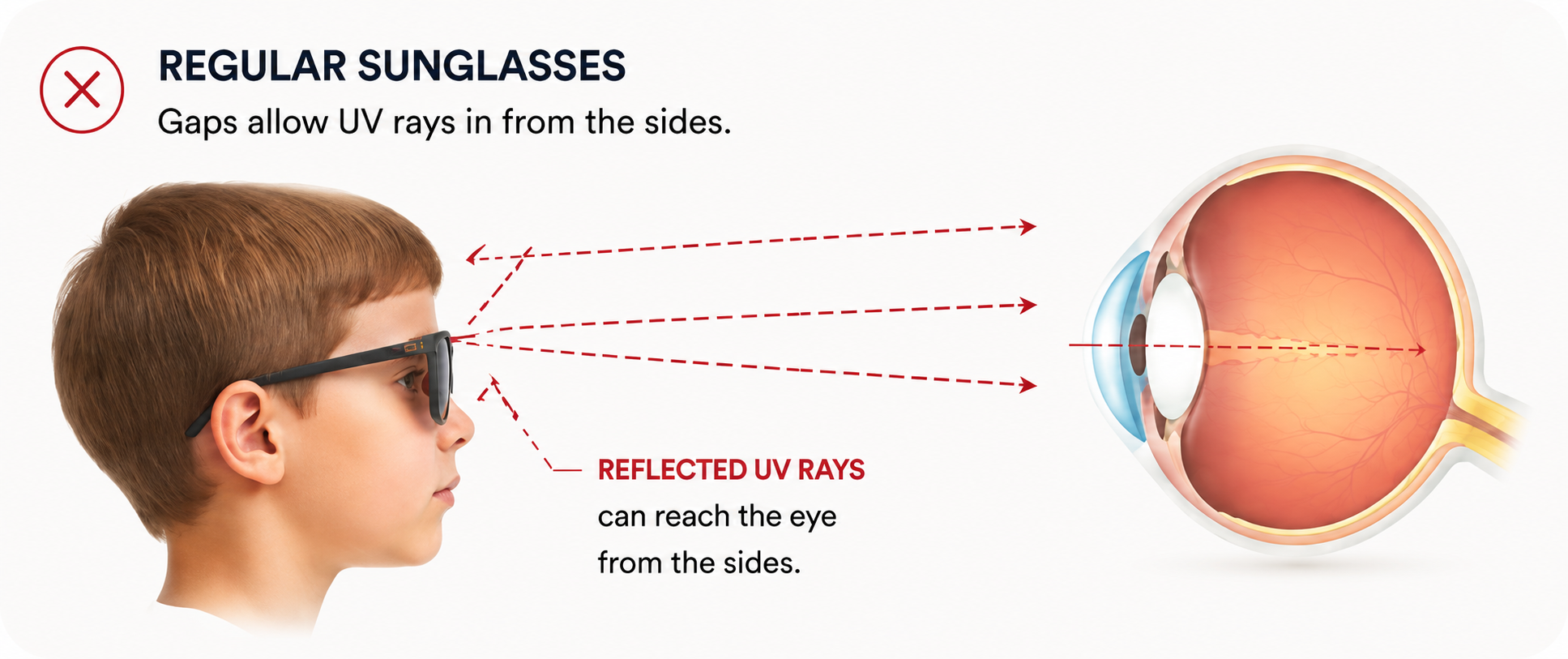
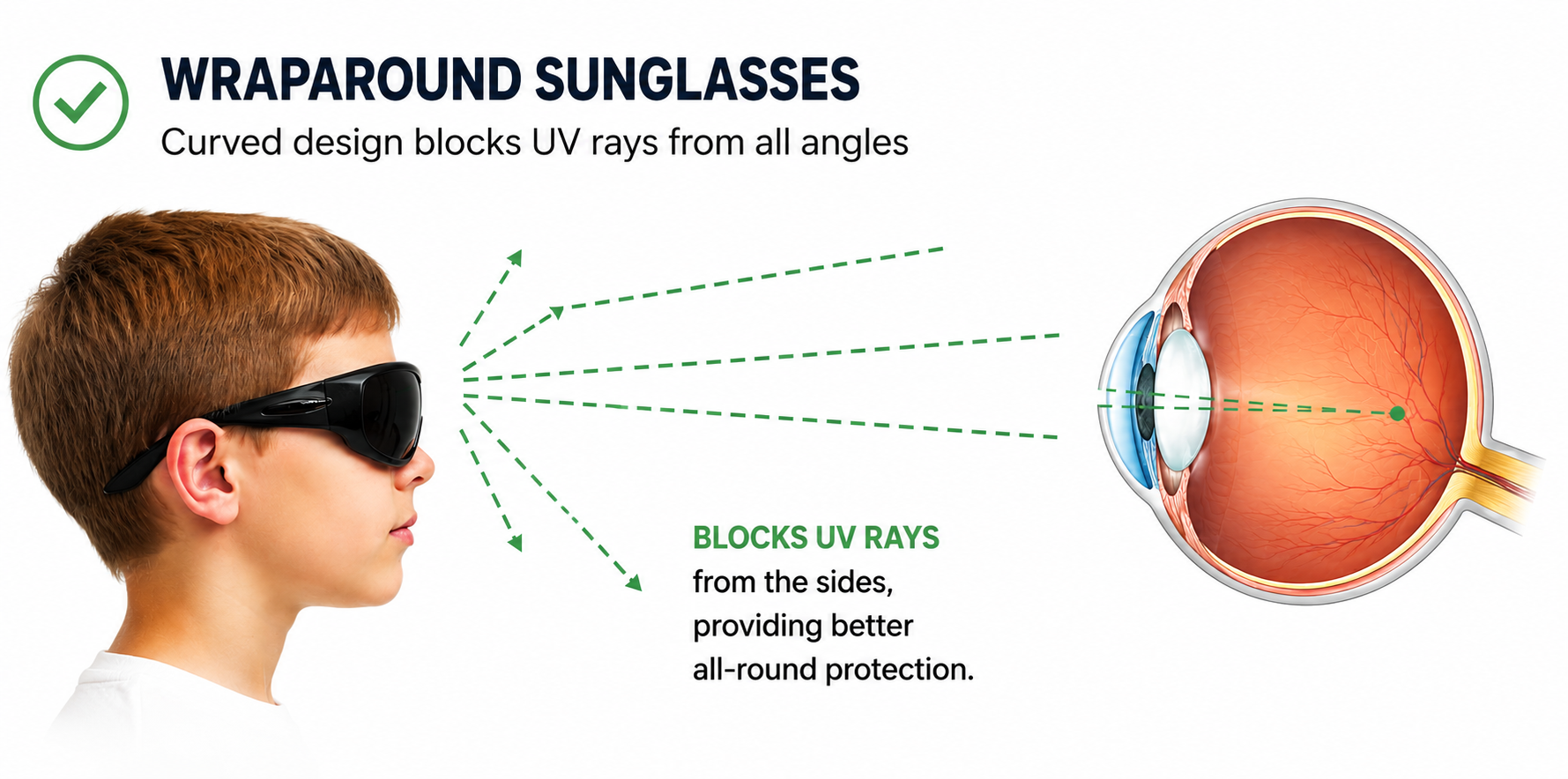
Wraparound sunglasses are one of the most effective ways to protect your child's eyes from UV damage every day.